
Move Strong, Live Strong: Fitness for Women’s Health and Confidence
How often do we put our own health on hold while managing everything else around us?
Between work, family, studies, and daily responsibilities, staying active can easily slip down the priority list. Yet, regular movement is one of the simplest and most powerful ways women can support their overall well-being.
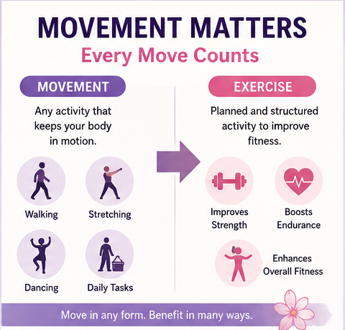
Exercise is essential for maintaining physical health. It supports heart function, improves blood sugar control, and reduces the risk of chronic conditions such as type 2 diabetes, hypertension, and certain cancers. The World Health Organization emphasizes that regular physical activity is vital for preventing non-communicable diseases and maintaining long-term health1.
At the same time, staying active has a strong impact on mental well-being. Women often carry multiple responsibilities, which can lead to stress and fatigue. Regular exercise helps reduce anxiety and depression, improves mood, and enhances mental clarity, making it easier to manage everyday challenges1.
As these benefits build over time, they contribute to overall fitness not just in terms of physical ability, but in feeling strong, capable, and confident. Fitness is not just about appearance; it reflects a balance of physical strength, mental resilience, and overall health.
Strength training and weight-bearing exercises are particularly important for women. They help build stronger muscles and improve bone density, reducing the risk of osteoporosis and fractures, especially during and after menopause. Stronger muscles also make everyday tasks like carrying groceries or climbing stairs easier and less tiring2.
Regular exercise is also closely linked to self-confidence. Research shows that women who stay physically active tend to have higher self-esteem and a more positive body image. Being active not only improves how the body functions but also how women feel about themselves3,4.
Over time, these physical and mental benefits enhance overall quality of life. Women who stay active often experience higher energy levels, greater independence, and increased motivation. They are better able to manage responsibilities while also taking care of their own well-being.
Choosing to stay active is more than just a routine it is a commitment to oneself. It is about building strength, improving health, and developing the confidence to live life fully and independently.
References:
- World Health Organization. (2020). WHO guidelines on physical activity and sedentary behaviour.
https://www.who.int/europe/publications/i/item/9789240014886
- Misra, A., et al. (2012). Consensus physical activity guidelines for Asian Indians. Diabetes Technology & Therapeutics, 14(1), 83–98.
https://doi.org/10.1089/dia.2011.0111 - Anjana, R. M., Nitika, S., Sinha, S., Kuriyan, R., Pradeepa, R., Palmer, C., Kurpad, A. V., Mohan, V., Sallis, J., & Ranjani, H. (2021). A Novel High-Intensity Short Interval Dance Intervention (THANDAV) to Improve Physical Fitness in Asian Indian Adolescent Girls. Diabetes Technology & Therapeutics, 23(9), 623–631. https://doi.org/10.1089/dia.2021.0028
- Anjana, R. M., Nitika, S., Jagannathan, N., Vinothini, D., Yuvarani, K., Mohan, V., Pradeepa, R., Palmer, C. N. A., O’Shea, M., Goenka, S., Manian, R., Karthik Raj, A., Surendran, S., Unnikrishnan, R., Sallis, J. F., & Ranjani, H. (2025). A Novel High-Intensity Short Interval Dance Intervention (THANDAV) for Non-Communicable Disease Prevention Tailored to Asian Indian Adolescent Girls. Journal of Diabetes Science and Technology, 19(4), 1035–1050. https://doi.org/10.1177/19322968251332925